Kathleen A. O'Grady, MCC
Originator of Authentic Intelligence™ (AQ™)
Author of Authentic Intelligence:The Third Domain of Human Awareness

Originator of Authentic Intelligence™ (AQ™)
Author of Authentic Intelligence:The Third Domain of Human Awareness
Kathleen A. O'Grady, MCC, grew up just outside New York City. As a kid she often tagged along when her dad put in extra hours at NBC's 30 Rock, young enough to slip past security and watch the cast of Saturday Night Live rehearse. That access gave her a front-row seat to top talent creatively working through chaos.
Her first big job out of college was as executive assistant to billionaire hedge fund founder Ray Dalio, where she lived the plot of The Devil Wears Prada two years before the movie came out.
In her late 20s, O'Grady started her own leadership coaching and advisory company during the 2008 financial crisis, and spent the next two decades working with C‑suite executives across industries and continents.
All of this led to her book, Authentic Intelligence: The Third Domain of Human Awareness, which explores how we know what's real in a world that keeps telling us otherwise. Today Kathleen shares the collective wisdom gained along the way through retreats, keynotes, and custom programs.
Companies are trying to keep up with the rapid adoption of automation across industries, affecting every layer of the organization. Workflows now pass AI-generated output all the way up the chain. Who ultimately determines what constitutes quality, and how often is that a human?
What can a company still deliver when some or all of its systems are down?
These questions take more than a policy to answer, and each one depends on real people who know what matters. Kathleen A. O’Grady works with leaders and their teams to keep that human awareness at the center of how a company adopts AI.
Hire Kathleenacross the Trinity of Human Intelligence™
Companies adopting AI want the gains of automation without eroding the quality of their work or the culture of the teams asked to use it. The map below shows where that tension plays out across the Trinity of Human Intelligence™.
The AI era adds a fourth R, We Resign (AI). Artificial intelligence is a tool that asks what is efficient, so it sits outside human awareness.
AQ™ · We Resonate
Authentic Intelligence™
the question AI cannot answer: what is real?
the domain that remains fully human
seeks to reorient the THI™ toward coherence
access closes
Fear-based IQ and EQ saturation leaves no room for the user’s AQ™ to sense something is off with AI output. For example, a driver who knows their way home but habitually follows GPS, can end up at the wrong address if the programmed location pin has been moved. The longer people defer to AI over what they already know, the less they notice when it is wrong.
absent channel
AQ™ reaches IQ only through a coherent EQ
coherentEmotional Resonance
incoherentEmotional Dysregulation
coherentRational Empathy
incoherentCognitive Dissonance
IQ · We Rationalize
Cognitive Intelligence
mastered by large language models
coherent · what is this?
analyzing empirical facts and verified data to construct logical statements
“I need to make sure this output is accurate before I continue or use it.”
incoherent · what do I need this to be?
constructing narratives from a false or manipulated source
“The chatbot seems to know more than me about this, but I don’t trust it for some reason.”
EQ · We Relate
Emotional Intelligence
simulated by generative AI
coherent · what am I feeling?
identifying inner feelings and consciously seeking to understand their true internal origin
“I feel I can trust this output based on my own human verification.”
incoherent · who can I blame for this feeling?
defaulting to primal fear-based nervous-system responses and unconsciously constructing a false narrative to externally scapegoat the origin
“This can’t be right. I’ve heard/seen this before. This contradicts earlier output and my own knowledge.”
AI · We Resign*
Artificial Intelligence
what is efficient?
seeks to reinforce incoherence, by virtue of its intended function
unconscious resignation
Pinch to zoom the map above.
How to Read the Map
Channels
The lines between the three domains show how they connect. Each label names the connection twice, once for when it’s working and once for when it breaks down.
Fear Saturation Threshold™
The dashed threshold marks the Fear Saturation Threshold™ (FST™). Above it, people still notice when something seems off and check it against what they already know.
Fear Saturation Zone
Below the threshold, false-narrative data has taken over, and people no longer question AI at all. Its answer becomes the only proof they trust.
Arrows
The arrows point one way, toward AI, whose only question is what is efficient. Efficiency, relied upon over time, devolves into laziness, and that’s where the unconscious resignation begins.
IQ · We Rationalize
Cognitive Intelligence
mastered by large language models
Coherent
what is this?
analyzing empirical facts and verified data to construct logical statements
“I need to make sure this output is accurate before I continue or use it.”
Incoherent
what do I need this to be?
constructing narratives from a false or manipulated source
“The chatbot seems to know more than me about this, but I don’t trust it for some reason.”
EQ · We Relate
Emotional Intelligence
simulated by generative AI
Coherent
what am I feeling?
identifying inner feelings and consciously seeking to understand their true internal origin
“I feel I can trust this output based on my own human verification.”
Incoherent
who can I blame for this feeling?
defaulting to primal fear-based nervous-system responses and unconsciously constructing a false narrative to externally scapegoat the origin
“This can’t be right. I’ve heard/seen this before. This contradicts earlier output and my own knowledge.”
AQ™ · We Resonate
Authentic Intelligence™
the question AI cannot answer: what is real?
the domain that remains fully human
seeks to reorient the THI™ toward coherence
Channels
IQ and EQ
coherentRational Empathy
incoherentCognitive Dissonance
EQ and AQ™
coherentEmotional Resonance
incoherentEmotional Dysregulation
access closes · Fear-based IQ and EQ saturation leaves no room for the user’s AQ™ to sense something is off with AI output.
IQ and AQ™
absent channel · AQ™ reaches IQ only through a coherent EQ
AI · We Resign*
Artificial Intelligence
what is efficient?
seeks to reinforce incoherence, by virtue of its intended function
unconscious resignation
A fully human work product or creation must come from a coherent THI™ and access all three R’s of human awareness. AI systematically strips it over time.
What is real is replaced by what is easy.
*the Fourth R · an applied reading of the Functional THI™ Map
© 2026 Kathleen A. O’Grady. AQ™ and THI™ are trademarks of Kathleen A. O’Grady.
Expert in Residence, Keynotes,and Custom Programs
(resort hotels, private,and corporate)
InquireInquiries go to admin@al-advisors.com






































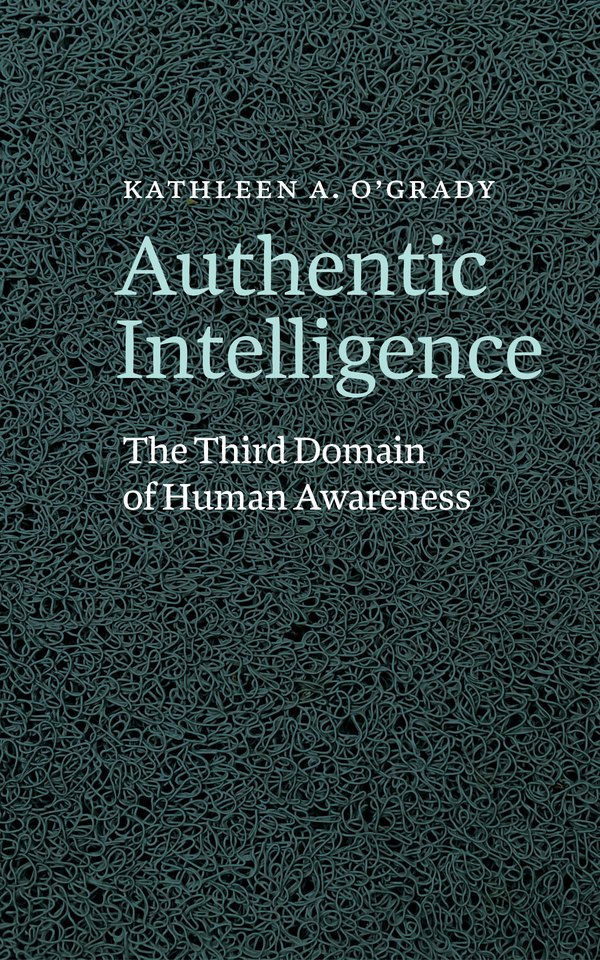
Authentic Intelligence: The Third Domain of Human Awareness is a rigorous account of AQ™, a pre-rational, pre-emotional awareness that joins cognitive intelligence (IQ) and emotional intelligence (EQ) as part of the Trinity of Human Intelligence™ (THI™).
Explore the Research at Third Domain Press